
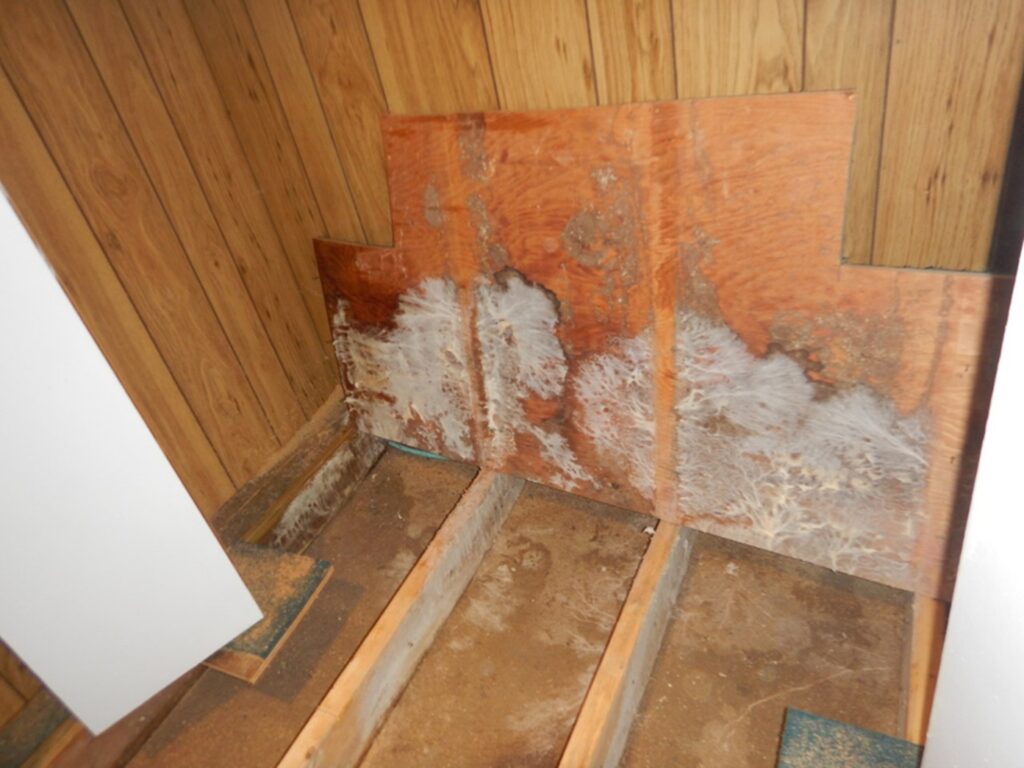
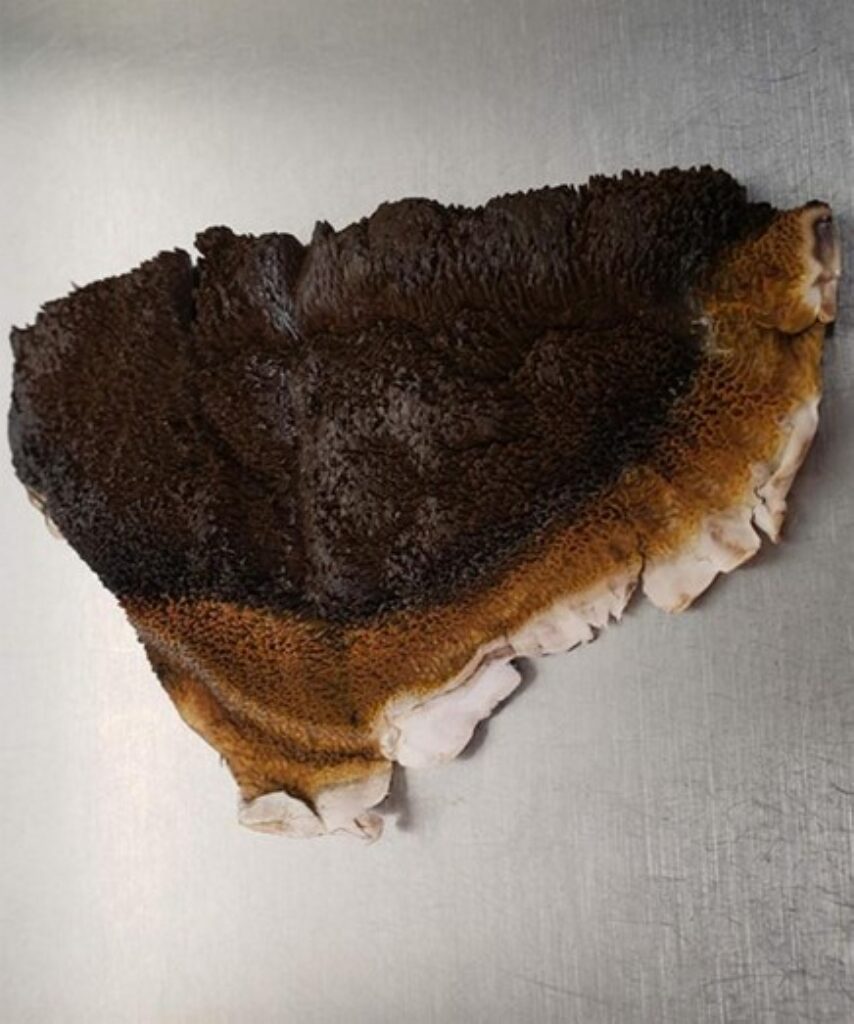
Often, there’s the conviction that weeping merula only affects other people. That it only affects abandoned houses, cases of serious disrepair or insalubrity.Until, that is, it invites itself into your home. This is exactly what Marie-Hélène Cauchon, Director of Mérule Québec, experienced when she discovered that her own home was contaminated by this devastating fungus in 2014.
An article entitled“Le cancer du bâtiment: le connaître et le combattre”is available on the Lab Eau-Air-Sol website for a better understanding of the problems associated with this fungus.
In 2014, there is no plan, no significant assistance.Merula is little-known in Quebec, poorly documented, and even less supported by public authorities.Faced with a lack of government support, she and her husband decided to take matters into their own hands: he on the political front, she on the side of families and human experience. From this mobilization, between the involvement of several stricken homeowners, was born, in March 2018, the organization Merule Québec, a support point to break isolation and advance knowledge.
Weeping merula doesn’t just destroy wood.It also affects aspects of mental health.The psychological and emotional repercussions are numerous: financial stress, unforeseen debts, recourse to loans, work stoppage, depression, etc… Money intended for life’s projects suddenly finds itself in urgent work.
Added to this is the fear of social isolation, shame and sometimes even exclusion.Many avoid talking about it for fear of judgment or insurance consequences. Many find themselves alone in the face of an onerous, time-consuming and anxiety-provoking situation.
To meet these needs, Mérule Québec relies on available documentation and scientific literature, as well as collaborating directly with researchers to advance our knowledge.Indeed, all these actions have stimulated the implementation of projects aimed at better understanding weeping merula and continually improving identification and intervention practices.
Support is also provided through an online support group, facilitated by a social worker. During seven themed workshops, participants can share their experiences, express their fears and put into words the sense of loss or grief that the situation may engender. The feedback is very positive: beyond the information, it’s the feeling of solidarity that makes the difference. Knowing that others are going through the same ordeal helps them to regain a sense of empowerment and confidence in the future.
The number of merula cases varies from one year to the next, and appears to be declining based on the number of officially reported cases. Lack of political cooperation, the absence of mandatory reporting and fear of the consequences mean that many cases go unreported.However, this underscores the importance of raising awareness. The more people know about the problem, the more likely they are to talk about it and report it.
Finding a specialized contractor remains a challenge. For a long time, very few professionals ventured into this area of expertise, mainly due to a lack of knowledge and experience. With time, accumulated experience, training and more public discussion of the issue, a greater number of contractors are beginning to develop this specialization.
However, this remains an important issue, as the supply remains limited and not everyone has the same level of expertise.Errors in diagnosis or treatment can have catastrophic consequences, both financially and structurally, for homeowners. That’s why it’s essential to be well-informed and to surround yourself with competent specialists.
Since the financial assistance program was discontinued, the situation has become extremely complex. The assistance available is scarce, ill-suited to weeping mould, inconsistent and often conditional on strict criteria.
Homeowners find themselves having to choose between evacuating, staying put, or financing costly work themselves. Bank loans are difficult to obtain, especially for those who have just bought their home. Insurance companies generally exclude fungus and mold from their policies, and may even cancel a policy in the event of merula, which contributes to the silence surrounding the problem.So it’s important to inspect and intervene before the situation gets out of hand.
Once the work is finished, the fear doesn’t disappear completely.For many homeowners, the “aftermath” is one of constant vigilance.That’s why Mérule Québec recommends that you carry out a health check on your home every five years, in order to assess the state of health of the building and plan the work that needs to be done in the short, medium and long term.Learning to unplug or relax remains a real challenge when merula has occupied the entire mental space for months or even years.On the real estate market, when the work is well done and documented, the buyer is reassured.
The key is to play it down. Insurance companies are afraid of the merula problem, while the Internet only highlights worst-case scenarios.However, there are also stories with happy endings, but they are not very visible.
The best weapon against weeping merula is information. Talking openly about it encourages preventive inspections, detects situations earlier and considerably increases the chances of intervening before damage becomes major.Talking about weeping merula changes perceptions, encourages preventive inspections, promotes earlier detection and increases the chances of intervening before damage becomes major. The earlier we act, the more effective the solutions.Breaking the silence means building a stronger foundation for the future.That’s why it’s essential to do your homework and find a qualified specialist, in particular by relying on recognized laboratories such as Lab’Eau-Air-Sol, which has been carrying out fungal identifications for over 10 years.